Pages

Showing posts with label tradition. Show all posts

Monday, 29 April 2013

Bindi: A fashion statement or a wedlock symbol?


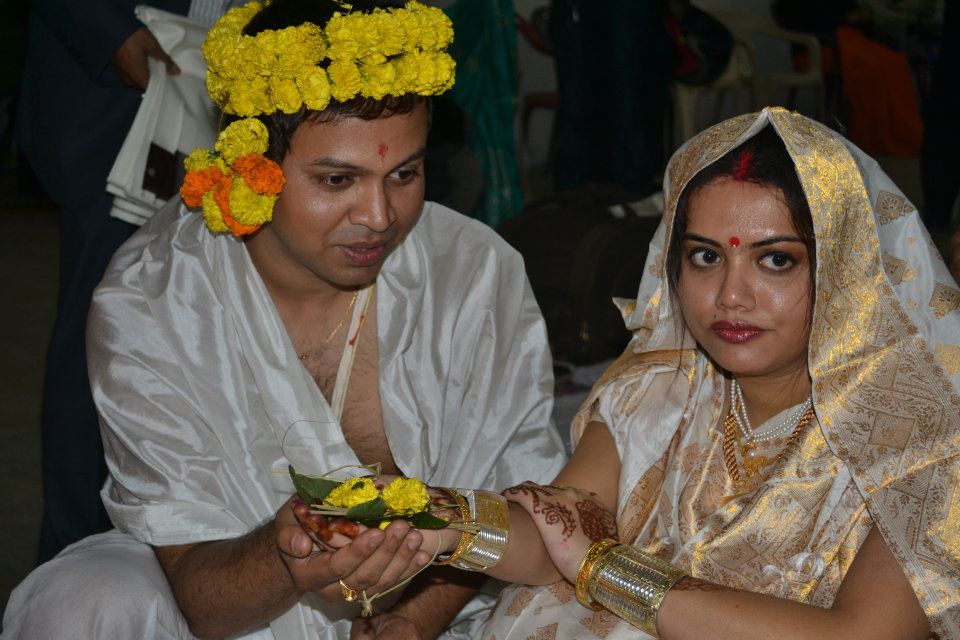
Bindi, although originated as a facial adornment on the forehead, yet it has become a mandatory practice for the women in India to wear it as heir wedlock symbol. A red dot on the forehead of a woman not only signifies her marital status, but also guarantees her sanctity and a position in the society. 


Be it men, women or vamps on television screens, a mark on the centre of their forehead has always remained a predominant factor of Indian facial adornment. Using the forehead as a canvas, this body art form has not limited itself to young girls and women.  If we take a close look at our past, we can see that even the males belonging to royal and high classes along with those belonging from the priestly families sported a mark between the two eyebrows.  Even in the 21st century, men who claim themselves as priests are seen portraying such marks on the forehead as well as on the other parts of their body.
But here, our concern does not lie on discussing the fact whether such signs represent rituals and customs? So, taking you directly to the point let me tell you that, although ‘Bindis’ are the most striking and charming face decorating elements, yet in some regions of India, like, West Bengal, Assam, Bihar or Orissa, it is mandatory for women to wear it as their wedlock symbol.
In our country, the gracious ceremony of tying the nuptial knot remains incomplete without the color red. From wedding attire to jewelry, red color holds a firm place in the weddings of North India. Hence, a red bindi between the two eyebrows of the Indian brides is said to be the symbol of love, which they would share with the members of their new family. Some also believes on the myth that, in Aryan society the groom used to put his blood on the forehead of the bride to declare themselves as legally wedded husband and wife.
However, with evolution of time, ‘Bindi’ too has undergone many changes and has become a fashion statement for many. It has gone experimental in the recent decades never like before.  From its red hued powdered form to multi colored sticker bindi, today it is available in several shapes and sizes along with different shades and designs.  Ornamented bindis available in precious and semi precious stones are popular among the women during festivals and celebrations.
Do you remember the big bindi on the forehead of singer Usha Uthup?  The “kaw” shaped bindi, which has become her style icon for years, is her expression of love for the city of Kolkata. 


The Indian television industry too played a vital role in providing the body decorating item a new look. Beginning from Mandira Bedi’s ‘Shanti’ (a reverse arrow shaped bindi) till Neena Gupta’s ‘Saans’, where the title logo of the serial portrays a red dot underlined with a black line, it became a fashion statement and a symbol of modern women.  While Ekta Kapoor gave an entirely new identity to the adornment by using the traditional round bindis for good homemakers, while all kind of question marks and triangle shapes are indicative of evil and vamps.
Today, bindi signifies different meaning to different people. While for some it is a fashion statement, for Indian brides, it is a symbolic of their married life. 


Shifting tradition of Arrange Marriages with the emergence of Matrimonial Sites!


Unlike in the West, where marriage is subjected to one’s own choice; in India, it is considered as an enduring unification between two families rather than two individuals. 
Indian Matrimonial Sites have taken the forefront in getting a perfect match for you, leading to cultural union.


 When we, the Indians, speak of Arrange marriage, we generally tend to think of a marriage, where a perfect match has been arranged by some dhoti-claded pundits or by a match maker known by our family.  But, with the evolution of matrimonial sites, the concept of traditional arrange marriage has changed immensely, and a new concept of online marriage has set its foothold.

Arranged Marriages in India: An overview                                                                    

Although the practice of finding a suitable match for an eligible boy or a girl has changed with the advent of newspapers, magazines or marriage websites, yet in some parts of India, parents or the elders still take the lead in finding an apt groom or a bride. However, unlike primitive times, today the children have to have their consent for their chosen partner so that they can live happily with each other post marriage.
In our country, when a marriage is finalized by the parents or the elders, they consider a myriad of details like, caste, the family background of the bride or the groom, educational and social status, economic backdrop of the family, lifestyle and culture, look and appearance of the couple, if the horoscope of the duo matches, and many more. In some cases, even casual background verification of the individuals is performed with the help of common friends and relatives. Such checking can provide a clear picture about the character, habits, nature or any prior affairs of an individual.  After a successful screening process, the acceptance comes from both the families and an enduring relationship is established between them.
Both the prospective bride and the groom are allowed to spend   some quality time with each other pre wedding, so that a successful arrange marriage can work out between the two .


Stand of Indian Matrimonial Sites in Shaping the Social Custom:

No doubt, the structure of extended family has become fragile over the decades paving the way for nuclear family. This has led to the lack of social connections which was hugely provided by the members of a joint family. Social networks are considered as a strong medium for the parents of the prospective couple in finding a suitable soul mate for their offspring.  However, with the prevalence of the nuclear family concept in the urban India, the traditional way of hunting for eligible bride and groom has undergone a change. People now-a-days prefer to seek the help of matrimonial advertisements in newspapers, marriage bureau, online marriage registration, Swayamvar on television, etc.
With the progress in information technology, online matrimonial services have made it much easier for the parents to find a suitable spouse for their kids. Many community and free matrimonial websites too have emerged for the convenience of the Indian families, which assures to find a perfect match within a week.  This has probably granted the ‘veto power’ to the marriageable candidate on any proposal introduced by their parents.